






enough about us.
Ready to Launch?



Fintech content isn’t just about keywords—it’s about clarity, compliance, and conversions. In this in-depth guide, we explore why fintechs need specialized content agencies, what these agencies actually do, and how they drive growth through expert-led, funnel-aligned strategies. You’ll learn the top benefits of working with a fintech-focused partner, red and green flags to watch for, real case studies from agencies like Mint Studios and Beyond the Arc, and how to evaluate your perfect match. Whether you're scaling a payment platform or launching a lending app, this guide will help you make the right choice—and see content as a performance engine, not just a publishing task.
Choosing a fintech content marketing agency is one of the most consequential decisions a fintech brand can make. The right fintech marketing agency doesn’t just produce content—it aligns strategy across SEO, content, and growth channels. Get it right and content becomes a compounding revenue channel — driving qualified leads, shortening sales cycles, and building the kind of trust that no paid ad can buy. This is where seo content marketing becomes critical, ensuring that content is not just created, but strategically optimized to rank, attract, and convert high-intent users. Get it wrong and you burn budget on generic blogs that never rank, never convert, and never move your pipeline.
This guide walks you through exactly what a fintech content marketing agency does, why your industry demands a specialist over a generalist, how to spot red flags before you sign, and the questions that separate agencies that deliver from the ones that just publish.
If you want a side-by-side comparison of top agencies instead, see our ranked list of the best fintech content marketing agencies.

Marketing in fintech is uniquely difficult. You are not just selling a product — you are translating complex financial concepts into content that is informative, compliant, and conversion-driven. From payment APIs to lending platforms to embedded finance tools, fintech offerings require a depth of understanding that most generalist content teams simply cannot provide.
Unlike e-commerce or SaaS, fintech brands must craft messaging that educates without overwhelming, assures without boring, and differentiates without confusing. A specialised content agency brings the domain experience needed to distill these topics into accessible narratives without sacrificing accuracy or authority.
Fintechs operate in one of the most tightly regulated digital sectors. Depending on your product, you may be subject to GDPR, CCPA, KYC, AML, or PSD2 — and your content marketing has to reflect that. A compliance breach in a blog post or landing page is not just an editorial problem. It is a legal and reputational one.
Specialised fintech content agencies understand where compliance meets communication. They know when to add disclaimers, how to represent financial risk accurately, and how to walk the fine line between persuasive and legally sound. This protects you from costly revisions, regulatory exposure, and brand damage that can take years to repair.
Technical accuracy is non-negotiable — but so is readability. A strong fintech content strategy must balance expert-level insight with emotional resonance. B2B buyers, retail investors, and first-time users all consume content differently, and your ideal customer profile (ICP) demands a different tone for each.
A good fintech content agency knows how to speak to a CFO evaluating compliance platforms with the same confidence it uses to guide a Gen Z user through a budgeting app. That balance of clarity and complexity is what turns readers into leads, and leads into customers.
Fintech content agencies do not start with a content calendar. They start with a diagnostic phase — mapping your sales funnel, identifying where leads drop off, and building a content strategy that addresses those gaps directly. Every deliverable ties back to a conversion metric, whether that is demo bookings, trial sign-ups, or inbound sales enquiries.
The best agencies prioritise bottom-of-the-funnel (BOFU) content from day one. Decision-stage content — comparison pages, pricing guides, objection-handling blogs — shortens the sales cycle and proves ROI faster than top-of-funnel awareness content alone.
Fintech buyers do not all consume content the same way. Some need long-form explainer blogs or regulatory guides. Others respond to video walkthroughs, customer case studies, or concise social content. A specialist agency produces the right format for each stage of the buyer journey:
• Long-form blogs that rank on Google and educate qualified prospects
• Case studies that translate product capability into real-world proof
• Whitepapers and investor-facing content for credibility and thought leadership
• Short-form video scripts and social posts for top-of-funnel reach
Fintech SEO is about intent, not just volume. This is a core principle of seo content marketing, where content is built around high-intent queries that directly map to business outcomes rather than just traffic. A generalist agency chases keywords like 'best credit card.' A fintech content agency targets queries like 'compare B2B cross-border payment platforms' or 'FCA compliance checklist for neobanks' — lower volume, but far higher buyer intent and far easier to convert.
The best agencies combine organic keyword data with paid search performance signals to prioritise content that brings in traffic that converts. Rankings are a vanity metric. Qualified leads are not.
Top-of-the-funnel content builds awareness. Bottom-of-the-funnel content closes deals. Fintech content agencies specialise in the content that most agencies ignore: comparison pages, integration explainers, pricing FAQs, onboarding guides, and objection-handling blogs designed to remove the final barriers to conversion.
This content is typically interview-driven — sourced from your product team, sales reps, and customer success leads — capturing the exact questions real prospects ask before they sign. It supports not just search ranking but also sales enablement, email nurturing, and retargeting.
What separates fintech content agencies from general content shops is their ability to work across your growth stack — not just produce deliverables in isolation:
• Paid media teams: to validate keyword performance before committing to long-form content
• Sales teams: to identify objection patterns and create enablement assets
• SEO teams: to map internal linking, schema markup, and tracking
• Design teams: to ensure content integrates into your UX and visual system
This cross-functional model means every piece of content—whether a blog or a landing page—connects to your broader growth engine, similar to how a performance marketing agency aligns campaigns with measurable outcomes.
Most content agencies start with brand awareness and top-of-funnel content. Fintech-focused agencies invert that model. They begin with high-intent decision-stage content that supports demos, trial sign-ups, and pricing conversations — so you see commercial traction faster, without waiting six months for SEO to compound.
Fintech products are dense. Features, APIs, compliance considerations, and integration workflows cannot be summarised by someone who skimmed your website. Specialist agencies build content from the inside out — interviewing your product managers, engineers, and customer success leads to capture insights that no external writer can replicate. The result is content that sounds like it was written by someone who actually understands your product, because it was.
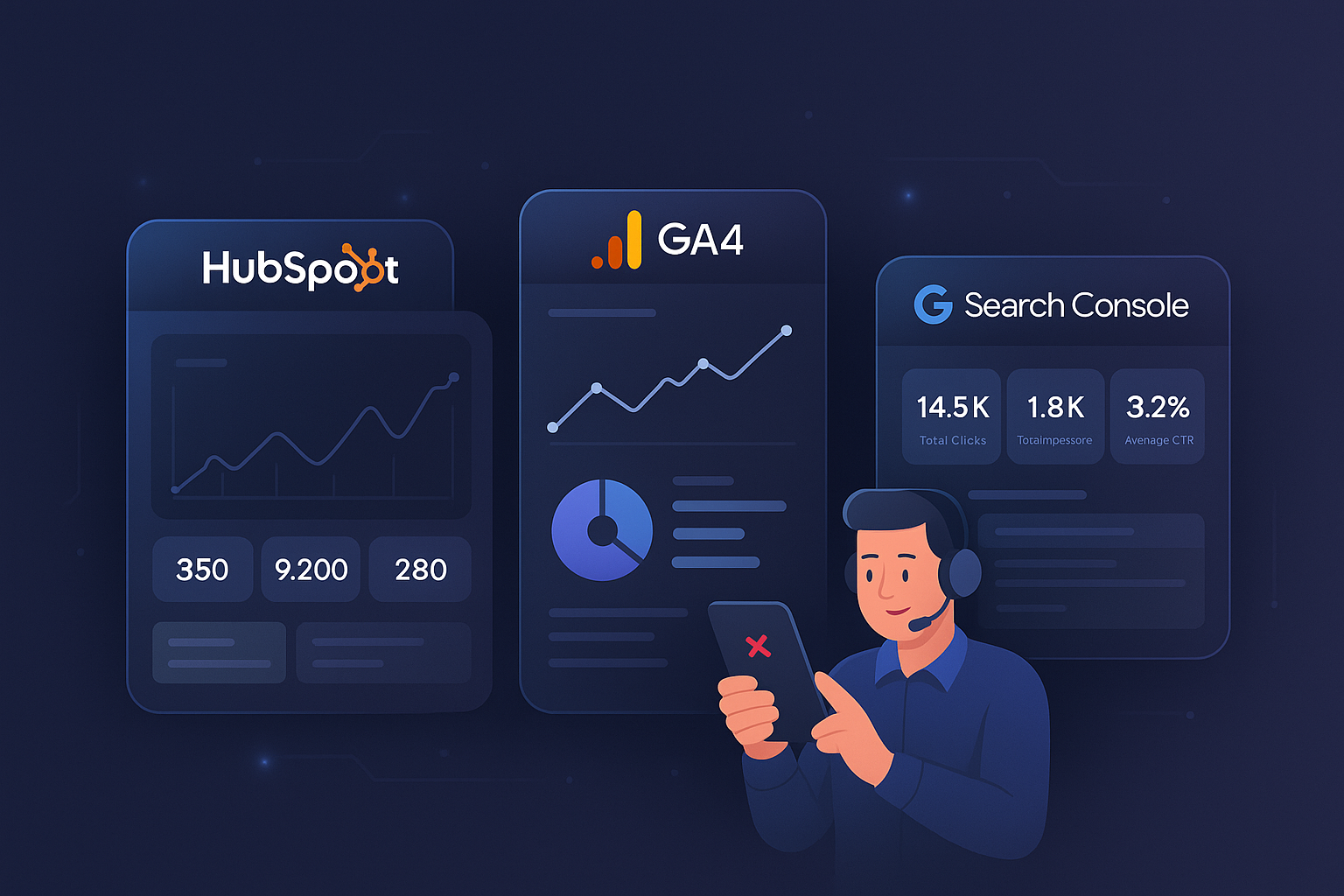
The best fintech content agencies build attribution systems from day one. Using platforms like HubSpot, GA4, and Google Search Console, they track not just traffic but which content influenced demo requests, which keywords drove qualified leads, and how long high-intent visitors engaged with BOFU pages. This turns content from a cost centre into a measurable revenue channel.
Scaling content across product lines, geographies, or audience segments is particularly challenging in fintech, where financial accuracy and compliance are non-negotiable. Specialist agencies have the editorial systems, compliance checklists, and distributed writing teams to grow your content library without introducing quality risk.
Beyond deliverables, fintech agencies bring systems: proven content templates built for regulated industries, keyword databases tailored to fintech niches, and teams who already understand financial regulations, buyer psychology, and competitive dynamics. This shortens your ramp-up time and reduces the risk of costly missteps in a high-stakes market.
See how Ballistic Media helped Eyes AI build a content and SEO engine that surfaces across traditional search and AI platforms — driving qualified sign-ups within the first 90 days. Read the Eyes AI case study.
A generalist agency that excels in e-commerce or lifestyle content is not equipped for fintech. Without domain knowledge, agencies misrepresent financial concepts, miss compliance triggers, use incorrect terminology, and produce content that reads as generic to sophisticated buyers. The cost of this is not just poor content — it is excessive internal review cycles, regulatory risk, and credibility damage that is slow to undo, which is why a fintech seo agency is the best choice.
Agencies that pitch one-size-fits-all content packages without asking deep questions about your sales cycle, compliance posture, or ICP are not the right fit. Red flags to watch for:
• Strategy documents that lack real user research or funnel analysis
• Topic lists based on competitor mimicry rather than buyer intent
• No differentiation between TOFU and BOFU content approaches
• Inability to articulate how a specific piece of content supports a specific business outcome
If an agency cannot tell you how their work connects to leads, pipeline, or revenue, you will spend budget without knowing whether it is working. This is more common than you might expect. Probe specifically for:
• KPI discussions during the proposal stage, not just after you sign
• Integration with HubSpot, GA4, or Search Console from day one
• Reporting that tracks conversion impact, not just impressions or word count
High-quality fintech content is research-intensive. It requires expert interviews, compliance review, and iterative editing — not a 24-hour turnaround. Agencies offering suspiciously fast delivery or below-market pricing are almost always cutting corners: relying on junior writers, AI-generated drafts without expert review, or templated output that will never differentiate you in a sophisticated market.
Mint Position is one of the agencies that have tackled SEO and its nuances carefully and offered their perspective:
Most fintech content looks the same. AI-generated blogs, recycled opinions, keyword-stuffed articles: the internet is flooded with it. Mint Position's clients needed content that actually stood out: original, authoritative, and built to convert.
Mint Position starts with questions, rather than just keywords. Their Journalistic SEO approach combines expert interviews, original research, and high-intent search strategy to surface insights that don't yet exist online, then maps them to the terms your buyers are already searching.
This directly targets what they call the "insight gap": the widening divide between generic information and genuinely new ideas. The result is content that can't be replicated without real expertise – a powerful differentiator in a crowded market.
Their Multi-Engine Optimization offer covers end-to-end SEO and GEO, BOFU landing pages, technical audits, and digital PR.
Impact
Working with fintech brands like Lula, Sarwa, and Duckfund, Mint Position has delivered #1 rankings and consistent B2B lead generation growth.
At a Glance:
The best content agencies feel like an extension of your internal team. This shows up in how they communicate, how they handle feedback, and how proactively they share ideas. An agency that pushes back with insight — rather than just executing briefs — will produce better work and catch problems before they become costly.
No one understands your product like your own team. Agencies that build content from internal expert interviews — product managers, compliance leads, sales reps — produce content that is more accurate, more differentiated, and more trusted by buyers. This approach also reduces your revision cycles, since the content is grounded in real knowledge rather than external research alone.
Look for agencies that operate with repeatable, documented systems — not vague content calendars. This means keyword-to-intent mapping, funnel-stage content planning, attribution modelling built into your CRM, and regular performance reviews that show progress against business outcomes. If an agency can explain exactly how a blog post supports a deal, they are the kind of partner that earns budget rather than justifies it.
Trustworthy agencies are upfront: about what is included and what is not, how long things take, how revisions are handled, and when you should expect to see measurable results. Agencies that offer diagnostic phases, fixed-scope pilots, or detailed roadmaps before a long-term commitment tend to be operationally mature — and far more likely to deliver what they promise.
Client: Eyes AI — an AI-powered SaaS platform
Agency: Ballistic Media
They needed more than a marketing website—they needed a strong foundation in website development to support performance-driven SEO and content systems. They needed a performance-driven content and SEO system that would surface across traditional search and AI platforms like ChatGPT and Google AI Overviews — and convert visitors into paying subscribers.
Ballistic Media built a content architecture around buyer intent: mapping target keywords to each stage of the funnel, creating SEO-optimised landing pages that communicated product value clearly, and ensuring the site was structured for both search engine crawlability and AI citation. Within the first 90 days of launch, Eyes AI was ranking for target keywords and generating qualified inbound sign-ups through organic search.
Client: Bankjoy — digital banking platform for credit unions
Agency: Beyond the Arc
Bankjoy needed to move prospects faster through their funnel and close sales more efficiently. Beyond the Arc developed a monthly content calendar focused on decision-stage topics — whitepapers and blogs addressing the specific digital banking challenges faced by credit unions. The result: increased organic traffic from high-intent prospects, stronger sales conversations, and prospects arriving pre-educated and ready to go deeper.
Client: Tilled — PayFac-as-a-Service payments platform
Agency: Mint Studios
Tilled wanted to build organic lead flow and reduce dependency on outbound sales. Mint Studios designed a founder-led LinkedIn and blog campaign built around weekly expert posts ghostwritten from interviews with the CEO. The focus was BOFU content that attracted qualified leads already evaluating payment solutions. The outcome: 75% of qualified leads became inbound, with a 59% close rate.
These examples share a common thread: content grounded in real product knowledge, aligned to a specific funnel stage, and measured against business outcomes — not publishing volume.
A strong fintech content agency will welcome scrutiny. These questions will surface both capability and fit:
• Have you worked with fintech clients before? Can you share specific results or case studies?
• How do you approach content strategy for regulated industries?
• What does your onboarding and diagnostic process look like?
• How do you ensure compliance accuracy in financial content?
• How will you measure performance beyond traffic — and what does success look like at 90 days, 6 months, and 12 months?
• Who will be writing the content, and what is their level of fintech expertise?
Many fintech content agencies now offer diagnostic phases or pilot projects before locking into long-term retainers. These are worth pursuing. A well-scoped pilot — one blog, an SEO audit, a content strategy document — tells you far more about an agency's thinking and communication than any proposal deck. It also gives you clear evaluation criteria on both sides before the real investment begins.
Content portfolios reveal how well an agency understands voice, audience, and funnel stage. When reviewing samples, ask yourself: Is this content structured around real buyer needs or just keyword density? Does the tone match the trust level your brand needs to convey? Is the subject matter accurate, specific, and genuinely useful to a fintech buyer?
Beyond samples, team chemistry matters. You will be working closely with strategists, writers, and editors. An agency that is curious about your product, asks sharp questions, and communicates clearly during early calls will almost always outperform one that simply delivers on schedule.
In fintech, content is not about visibility alone — it is about trust, education, and conversion. Every blog post, landing page, and case study carries your brand into a high-stakes conversation with buyers who are careful, sceptical, and sophisticated. That is why choosing the right fintech content marketing agency is a strategic decision, not a procurement exercise.
The right partner will build content rooted in real sales goals, translate complex products into clear and compliant messaging, measure performance against business outcomes rather than publishing volume, and scale without sacrificing the accuracy and trust your brand depends on.
If you are looking for a team that combines fintech expertise with SEO, Webflow development, and conversion-focused content strategy, Ballistic Media brings all of that together. We work with fintech brands to build content systems that earn trust and drive qualified growth — from first click to signed contract. Book a free growth call to see how we can help.
Fintech content has to be technically accurate, emotionally reassuring, and legally compliant — simultaneously. Unlike most industries, you are dealing with people's money, data, and financial decisions. Clarity, compliance, and trust are not optional extras. They are the foundation everything else is built on.
BOFU content — comparison pages, pricing guides, objection-handling blogs — can start influencing sales conversations within weeks, particularly when paired with outbound or paid campaigns. SEO content typically takes 3–5 months to gain meaningful traction, with compounding growth from months 6–12 onwards as authority builds.
Costs vary significantly by scope and agency tier. Specialist fintech content agencies typically range from £3,000–£15,000 per month ($4,000–$20,000), depending on content volume, strategy depth, and whether SEO, distribution, and attribution are included. Below-market pricing usually reflects junior writers, templated output, or AI-generated content without expert review — all of which carry higher hidden costs in regulated industries.
You can — but most freelancers lack the fintech domain knowledge, the strategic framework, and the cross-channel coordination needed to build a content programme that drives revenue. For regulated, product-specific industries like fintech, an agency provides structure, scalability, compliance oversight, and accountability that individual freelancers typically cannot replicate.
A fintech content agency works effectively as a strategic and production partner alongside internal teams. They can fill specialist knowledge gaps, scale capacity for specific initiatives like BOFU content or SEO campaigns, and provide the domain expertise and tooling that in-house generalists often lack.
The difference is domain depth. A general content agency can produce readable, well-structured content. A fintech content agency understands your buyer psychology, your compliance environment, your product's technical complexity, and the specific intent signals that separate a curious visitor from a qualified buyer. In fintech, that difference is the difference between content that ranks and content that converts.
Ballistic Media specialises in building high-performance fintech websites and content systems that drive qualified organic growth. Whether you are launching a new product, scaling your content programme, or looking to turn search traffic into real pipeline, we combine SEO strategy, expert content creation, Webflow development, and conversion-rate optimisation into one integrated growth system. Reach out for a free strategy call tailored to your fintech growth goals.
Most growth problems aren’t about a lack of ideas—they’re about execution. If you want support applying proven marketing and SEO strategies to your business, we’re happy to take a look.