






enough about us.
Ready to Launch?




A practitioner-grade breakdown of eight fintech marketing campaigns that delivered measurable results, plus the tools and firm-selection framework B2B teams need to replicate the wins.
Most fintech marketing lists are graveyards. They’re stuffed with 2021 campaigns funded by zero-interest-rate money that nobody is trying to replicate in 2026. That’s not useful. What is useful: the small set of campaigns since 2023 that actually moved a number — downloads, consideration, pipeline, revenue — and did it without torching the burn rate.
Fintech customer acquisition cost climbed to roughly $1,450 per customer in 2026, up 40–60% since 2023, according to First Page Sage’s CAC benchmarks. In that world, a campaign isn’t a brand indulgence — it’s the cheapest unit-economics fix you have, assuming it lands. This article breaks down eight of the best fintech marketing campaigns running between 2023 and early 2026, and the specific creative, distribution and measurement moves you can steal for your own growth plan.
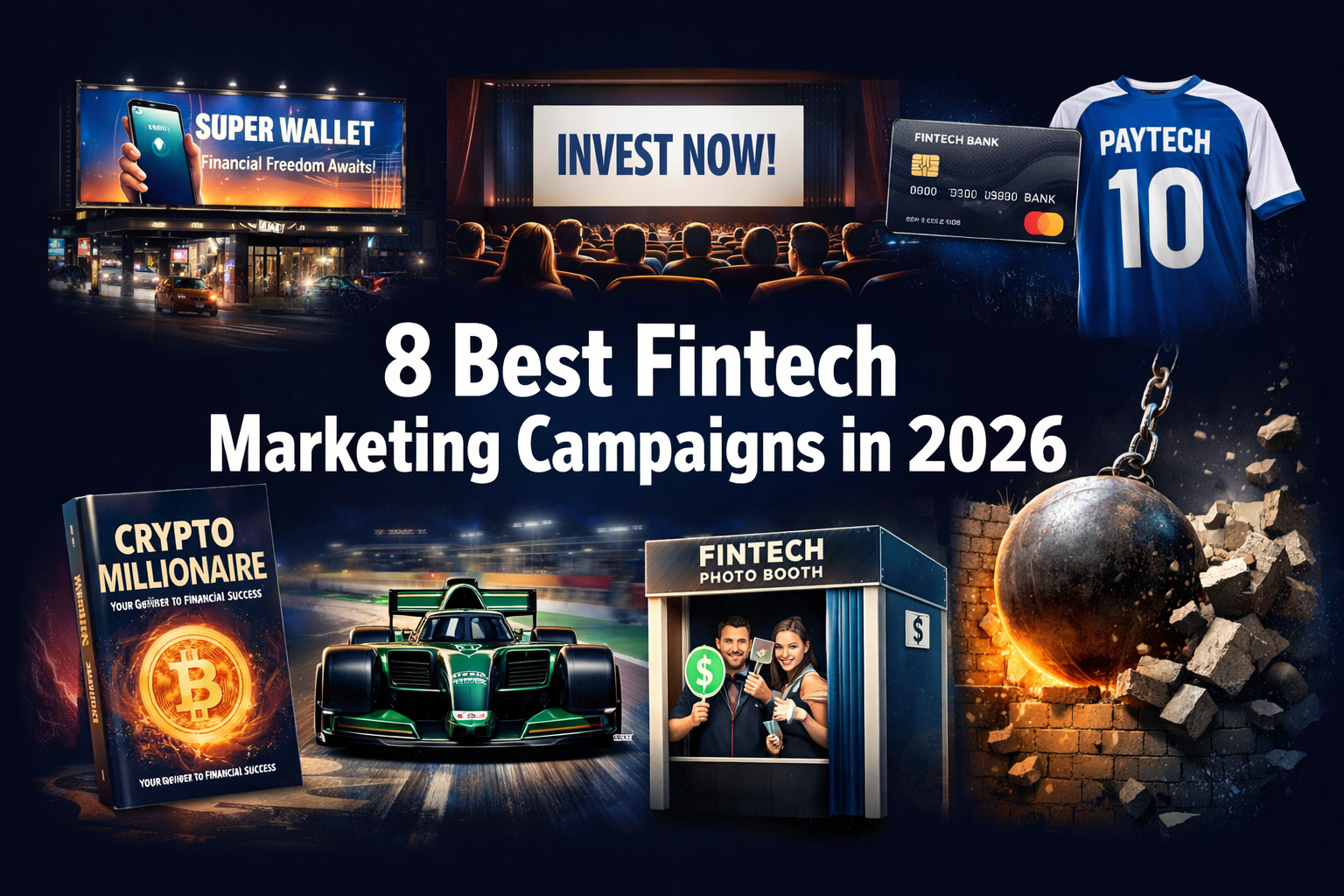
TL;DR Eight fintech marketing campaigns from the last 36 months — Nuvei x Ryan Reynolds, Revolut “Money Possibilities”, Airwallex “Future of Finance” + McLaren F1, Cash App x Timothée Chalamet, Chime x Jason Momoa, Monzo “The Book of Money”, Klarna x Paris Hilton, and SoFi “Face of Finance”. For each, we cover the creative, distribution, measured results and the playbook move you can lift. We also break down the best tools for fintech marketing campaigns in 2026 and how to pick marketing firms specializing in fintech branding and campaigns.
Fintech creative operates under three pressures that consumer brands rarely feel at the same time: regulatory compliance, skepticism about trusting a new brand with money, and product complexity that’s genuinely hard to explain in a six-second pre-roll. The campaigns that break out don’t pretend those constraints don’t exist — they turn them into creative fuel.
Fintech marketing campaigns that actually perform tend to share five traits, drawn from teardowns of paid media, brand tracking studies, and post-campaign interviews with the marketers who ran them:
• A single, memorable promise. They anchor on one sharp promise. Not a feature list — one claim the CFO could repeat in a lift pitch.
• Creative married to a product truth. Every creative execution ladders back to a product truth — borderless money, faster payouts, lower fees — instead of abstract vibes.
• A scalable creative system. The campaign runs in systems, not one-off hero ads. Brand codes, templates and assets scale across OOH, social, performance and lifecycle without losing cohesion.
• A defensible measurement model. Success is tracked against real metrics — CAC, consideration, app installs, pipeline, revenue — not just reach and impressions.
• Compliance by design. Compliance and legal are baked into the workflow from day one, not bolted on in the last 48 hours before launch.
The eight campaigns below do all five. They also span every format a modern fintech growth team is likely to use — celebrity endorsement, experiential activation, sports sponsorship, short-form video, and full-funnel content — so you can map the examples to whatever channel mix you’re working with.
Canadian payments giant Nuvei processes over $200 billion a year, but in early 2023 it was still largely invisible outside industry circles. Then Ryan Reynolds announced a personal investment and stepped in front of camera for a series of comedic B2B spots — unheard of in enterprise fintech advertising — leaning into Canadian clichés with his trademark arch delivery.
The campaign, first reported in Campaign Canada and Fortune, was designed to punch far above Nuvei’s awareness weight by borrowing Reynolds’ earned media halo — the same playbook that scaled Aviation Gin and Mint Mobile.
Awareness lift
Went from relatively unknown B2B brand to one of the most-recognised North American payments companies, according to a post-campaign teardown from Mint Studios.
Sales enablement
SDRs report using Ryan-specific openers to unlock previously cold enterprise conversations.
Earned media
The collaboration unlocked CNBC, Business Insider and Fortune features Nuvei historically had to pay to access.
The creative inverted every expectation for B2B payments marketing. Where most acquirers and processors run dry product demos, Nuvei treated its buyers like humans — CFOs, treasury leads, heads of payments — who happen to watch the same Ryan Reynolds content as everyone else. The ad itself was a Trojan horse; the real mechanism was the earned media and enterprise conversation it unlocked.
If you’re a B2B fintech with a real product story and a funded awareness gap, a single high-trust celebrity or operator partnership can compress 18 months of brand-building into one quarter. Budget for the earned media and sales enablement assets, not just the spots.
Revolut returned to brand marketing at the end of 2024 with “Money Possibilities”, a global campaign built with agency Anomaly London. Unlike its earlier combative “Your Way In” work, this one is abstract — wool being stretched and reshaped, surreal tactile worlds — and focused on a single idea: Revolut is not a banking app, it’s a gateway to everything your money can do.
The campaign ran for eight weeks across more than 20 countries, spanning film (directed by Ian Pons Jewell), TV, OOH, DOOH, social and audio, according to Campaign Brief Australia and The Drum. In January 2025, Revolut also ran its first-ever above-the-line campaign on Netflix, per Mi3.
“This campaign takes consumers literally into their own pockets, to experience the multidimensional world of Revolut — where money doesn’t only do so much more, but actually feels different too,” said Camilla Harrisson, CEO of Anomaly London, in Mobile Marketing Magazine.
Revolut crossed 50 million customers during this period and needed a brand platform that scaled beyond its scrappy early positioning. Abstract visual storytelling let the same creative system work in French metro stations, Australian streaming ads and Brazilian TV without rewriting the spots. The wool motif became a shareable visual code — the rare fintech campaign that actually produced memeable brand assets.
At scale, you don’t need a clever product demo — you need a distinctive, ownable visual code that can be repurposed across every channel. Build the system once; the campaign becomes cheap to localise.

Australian B2B fintech Airwallex ran one of the most disciplined fintech marketing campaigns of 2025. The “Future of Finance” platform, developed with creative agency Special and Accenture Song, dropped six high-production films of heavy machinery — wrecking balls, bulldozers, wood chippers — reducing the symbols of legacy banking to rubble. Paper stacks. Filing cabinets. Analog timezone clocks. The “please hold” call centre trope.
“Airwallex isn’t simply redefining finance, we’re reimagining it from the ground up,” Andrew Balint, VP of Marketing APAC at Airwallex, told FF News. “The proof is in the data: $900 million annualised revenue, $200 billion in transaction volume, and 13,000+ new customers in Q2 2025 alone.”
Airwallex followed the brand campaign with a nationwide OOH screen takeover in December 2025 to celebrate McLaren Racing’s F1 Constructors’ Championship and Lando Norris’ first drivers’ title. In partnership with oOh!media, the brand flipped more than 930 digital screens across every major Australian city to a unified celebratory message within seconds of the championship confirmation.
Revenue run-rate
$900M annualised revenue in Q2 2025 (up 89% YoY), per Airwallex mid-year mission update.
Transaction volume
$200 billion processed in Q2 2025.
New customers
13,000+ acquired in a single quarter.
OOH takeover reach
~4.92 million Australians in a single day across 930+ digital screens, according to oOh!media and Mumbrella.
Dry B2B fintech marketing usually stacks feature bullets. Airwallex went the opposite way: a metaphor so blunt (wrecking balls, literally) that every viewer instantly understood the competitive frame. Then it ran a real-time sports sponsorship activation that earned news coverage, turning a partnership asset into a cultural event.
Pair a brand platform (why we exist) with at least one high-visibility “moment” campaign (why we matter now). The brand platform makes the moment legible; the moment makes the brand platform memorable.
In 2025, Cash App stopped making commercials and started making short films. The brand partnered with Emmy-nominated director Aidan Zamiri and writer Elijah Bynum on “Heirloom”, a two-minute film starring Timothée Chalamet and Didi actor Izaac Wang. Chalamet walks into a rare-veg shop where the owner refuses anything but ancient forms of payment — salt blocks, cowrie shells — while the shopkeeper’s teen son makes the case for modern tools like Cash App.
Cash App premiered the film in cinemas ahead of blockbusters Superman and The Fantastic Four: First Steps before rolling it out to YouTube, OOH in New York and LA, and limited-edition Cash App Card stamps designed with Chalamet, per The Hollywood Reporter.
Most fintech apps fight for the same 15-second pre-roll slots. Cash App bought premium cinematic attention instead — a captive audience, a trusted cultural director, and a genuine story. The cinema premiere also made the content press-worthy, which is what turned a $X million short film into ~$Y million worth of earned impressions. As Ad Age reported, Cash App CMO Catherine Ferdon has been systematically rebuilding the brand around talent-led short-form film for several years.
Long-form creative is undervalued in fintech. If your CAC is $1,400+ and your paid channels are saturated, a single high-quality film placed in a premium context can deliver more compound brand equity than six months of performance spend.
Chime × Jason Momoa — Bank Smarter This Season
Chime’s first-ever holiday campaign, “Bank Smarter This Season”, launched in October 2025 across national TV, digital, social and streaming. It cast Jason Momoa as multiple everyday shoppers — a stressed dad, a harried gift-buyer, a ‘treat yourself’ spender — each navigating holiday chaos while Chime sits quietly in the background as the one thing that works.
The second spot, “New Day”, dropped on Christmas Day 2025 to extend the platform into a year-round brand play, according to Adweek.
Consideration lift
+15 points in creative testing, per Chime’s October 2025 announcement.
Brand equity lift
20+ points across key brand equity attributes.
New enrollments
Exceeded every previous Chime brand creative.
Holiday creative usually tilts saccharine. Chime leaned into the actual experience of seasonal spending — the stress, the receipts, the quiet dread of January — and used Momoa’s range to play it for humour instead of guilt. That contextual relevance is the payoff. Chime’s core audience (younger, low-to-middle income, mobile-first) reads the spots as this brand actually understands my life, which is the fastest path to trust in financial services.
Seasonal campaigns only work when they solve a seasonal problem. Map your product value to a calendar moment your customers are already thinking about, then make sure the creative acknowledges the real friction — not a sanitised version of it.
UK digital bank Monzo published The Book of Money — a jargon-free personal finance guide — and then built an entire OOH and experiential campaign around it with creative agency BBH, media agency Starcom and reporting from LBB and Creative Salon.
The campaign opened with a Soho pop-up called the Book Nook — visitors could generate a personalised book cover reflecting their own financial goals, like “Covering my bills and my bucket list” or “Making ‘some day’ an actual day”. BBH then scaled the idea: a two-week December takeover of Oxford Circus Underground station, digital escalator panels, tube car panels and DOOH across London, all built from the same coral-coloured book shot in every imaginable context.
This is a masterclass in one idea, executed a thousand ways. The book is the brand code. The personalised titles are the local variance. That gave BBH and Monzo the cheapest imaginable asset production model for a city-wide campaign, while creating the feeling that every passer-by saw an ad about their life specifically. It also solved a real fintech growth problem — financial literacy — which gives the campaign genuine PR longevity beyond the two-week burst.
If your fintech serves early-career or first-time customers, education-as-campaign is one of the highest-leverage plays you can run. Build an owned content product (book, course, report), then use it as the creative substrate for paid, OOH and organic simultaneously.
Klarna’s February 2023 multimedia campaign with Paris Hilton, in partnership with her 11:11 Media, leaned hard into Y2K nostalgia. Hilton — dressed in early-2000s fashion — reacted to Klarna’s flexible payments, buyer protection and package tracking features with a new catchphrase: “That’s Smoooth”, a direct riff on her famous “That’s hot.”
The campaign ran globally across social, digital, broadcast and OOH, including Hilton’s personal TikTok, with films directed by Grammy-nominated Tanu Muino, per the Klarna press release and Campaign.
US app downloads
+67.6% lift, per agency case study write-ups.
Earned media
Extensive coverage across fashion, finance, and pop culture press.
Audience
Converted Gen Z/millennial pop culture attention into app installs without a celebrity investment deal.
Klarna nailed the nostalgic-celebrity-as-catchphrase formula: a memorable line, a celebrity who benefits creatively from revisiting their own icon status, and a product with a clear, one-sentence value prop. It also proved that fintech marketing campaigns don’t need a Super Bowl ad to land — they need a cultural hook sharp enough to travel without paid reach.
If the celebrity’s personal brand maps to a simple product phrase (Smoooth = frictionless payments), you can pack almost every media asset into one line. That’s how you extend a campaign from a single hero spot to dozens of low-cost repurposes.
In June 2023, SoFi asked generative AI models to produce images of “people who are good with money.” Only 2% of the outputs featured women. SoFi turned that finding into a multi-channel brand platform called Face of Finance — part social experiment, part brand purpose campaign, part lead generation play.
SoFi ran a pop-up photo booth at Brookfield Place in New York City on June 22–23, 2023, inviting women to contribute real imagery that could be fed back into training sets. As Fortune reported, hundreds of women participated across the two days. Social entrants who used the campaign hashtag and tagged @SoFi were entered to win tickets to a Taylor Swift or Beyoncé concert at SoFi Stadium (retail value ~$2,200 per pair).
SoFi turned a live cultural conversation (AI bias) into a brand claim it actually had standing to make — it funded its women’s personal finance content commitments and a Coursera personal finance course off the back of it. Unlike most “purpose” work, the campaign produced a tangible deliverable (real imagery, a public experiment, a PR-worthy statistic) instead of a vague pledge.
The best purpose-led fintech marketing campaigns start with a real number, not a sentiment. The “2%” statistic did all the work of PR buzz, creative hook and call-to-action in a single figure. Find your own “2%” — the specific, defensible data point that exposes a problem only your brand is positioned to solve.
Eight campaigns. Four continents. B2B and B2C. Celebrity-led, experiential, content-led, OOH, cinema, content-product. On the surface they look unrelated. Underneath, they run the same operating model.
Nuvei: we’re the nicer, Canadian one. Revolut: everything your money can do. Airwallex: the old system is getting demolished. Cash App: your payment method says something about you. Chime: banking that doesn’t wreck your holiday. Monzo: a book for the money question you’re too embarrassed to ask. Klarna: smooth. SoFi: change the face of finance. One line. Memorable. True.
Every campaign here produced dozens or hundreds of assets from one idea. Monzo’s coral book appears on escalators, in tube stations and as personalised Book Nook covers. Airwallex’s wrecking-ball visual language powers six films, hundreds of social cutdowns and a nationwide OOH moment. That’s the only way to get repeat exposure without your CAC leaking.
Chime reported a +15 point consideration lift. Klarna measured +67.6% app downloads. Airwallex tied the campaign to $900M annualised revenue and 13,000 new customers in a single quarter. You do not need to publish these numbers — but you absolutely need to have them. Brand campaigns without measurement are indistinguishable from expensive wishes.
Financial services marketing campaigns that survive legal review start with legal in the brief, not at the final proof. Every campaign above ran across multiple regulated jurisdictions without compliance-driven rework — a signal the teams set up approval systems before creative kickoff.
Creative is only as good as the stack delivering it. Based on marketing-operations teardowns from MarTech Cube, Improvado and our own work with fintech clients, these are the tool categories running the best fintech marketing campaigns of 2026 — and the specific platforms dominating each one.
What are the tools helpful for fintech marketing campaigns? The pattern above matters more than the individual logos. You need data (CDP + analytics), creative (design + AI), distribution (paid + lifecycle) and governance (compliance + approvals). Any combination of the leading tools in each category will work; what kills campaigns is missing an entire category.
If you read the credits on the campaigns above, you’ll see the same pattern: fintechs with serious brand ambition work with marketing firms specializing in fintech branding and campaigns — not generalist agencies. The reason is simple: regulated-industry creative lives or dies on compliance familiarity, and fintech lives or dies on being able to explain complex financial primitives without losing the plot.
Before you shortlist b2b fintech marketing experts for growth campaigns, score each firm against these six criteria:
• 1. Fintech-specific proof. Can they point to at least three fintech-specific case studies with measured business outcomes (not just reach)?
• 2. Integrated capability. Do they have in-house strategy, creative and performance, or are they stitching freelancers together? Compliance rework is brutal with loose teams.
• 3. Compliance workflow. Ask for their approval and QA workflow. Serious fintech agencies have a named process for legal sign-off — amateurs will hand-wave.
• 4. Stack fluency. If you’re on Webflow, HubSpot, Segment or your brand CMS, the firm should treat your stack as a first-class citizen, not a blocker.
• 5. Measurement mindset. The firm should answer ‘how will you measure this?’ with CAC, LTV, consideration lift or pipeline — not impressions and reach.
• 6. Throughput at speed. Campaign speed isn’t a luxury in fintech. Look for modern, AI-assisted creative workflows that can scale variants without ballooning cost.
At Ballistic Media, we’ve built our fintech practice around this checklist. We’ve delivered a 250% marketing ROI average across 300+ projects, retain 97% of our clients and run 50+ fintech and SaaS campaigns a year — across paid media, B2B SEO, SaaS web design and fintech UX.
A successful fintech marketing campaign in 2026 earns trust quickly, explains a complex product in a single sentence, and scales across paid, OOH, content and lifecycle without looking fragmented. With fintech CAC now averaging $1,450 per customer, campaigns are also judged on real business metrics — consideration lift, funded accounts, LTV:CAC ratio — not just reach. The eight campaigns in this article all ship against a clear central promise and ladder every asset back to a measurable outcome.
The core mechanics are the same: sharp promise, creative system, measurement, compliance. But b2b fintech marketing campaigns have longer sales cycles, higher-stakes buyers (CFOs, treasurers, heads of payments) and need to survive procurement and legal review. Successful B2B examples like Nuvei and Airwallex lean into those realities with celebrity-led awareness plays, thought leadership and high-visibility sponsorship moments, instead of trying to out-perform a B2C app on install CPMs.
There’s no universal answer, but most growth-stage fintechs run marketing at 15–30% of revenue, split roughly 40% brand and awareness, 40% performance and lifecycle, 20% content and SEO. The exact mix depends on your CAC payback goal: if you need to recoup in under 12 months, shift weight into performance and lifecycle; if you’re playing a longer LTV game, heavier brand and content investment compounds better. In either case, keep a defensible measurement story — LTV:CAC, payback period, incremental lift — ready for every board meeting.
The best channel is the one your ICP actually lives on, but the high-performing fintech campaigns of the last 36 months concentrate around five: paid social (Meta, TikTok, LinkedIn), cinema and streaming (Cash App, Chime), OOH in high-density commuter corridors (Monzo, Pleo, Airwallex), sports and cultural sponsorships (Airwallex × McLaren, PensionBee × Brentford FC), and content SEO — particularly for B2B fintech, where compound organic traffic consistently beats paid in blended CAC.
At minimum: a CDP (Segment, Hightouch), an engagement platform (Braze, Iterable or CleverTap), an analytics and attribution tool (Mixpanel or Amplitude; Dreamdata for B2B), a paid media suite (Meta, Google, LinkedIn), personalization (Mutiny, Optimizely), creative production (Figma, Adobe Firefly), and approval governance (Filestage, Ziflow). See the Best tools for fintech marketing campaigns in 2026 section above for the full stack.
Start with case studies that report measured outcomes — CAC, pipeline, consideration lift, not just reach. Ask every firm on your shortlist for their fintech-specific compliance workflow. Check whether their strategy, creative and performance capabilities are integrated or stitched together. Map their stack fluency (Webflow, HubSpot, Segment, Braze) to yours. Then test on a small brief before signing a retainer. The six-criteria checklist earlier in this article will save you 80% of the bad-fit conversations.
The best fintech marketing campaigns of the last three years aren’t winning because they spent more. They’re winning because they anchor on one sharp promise, build a creative system that scales, measure against real numbers, and treat compliance as a design constraint instead of a last-minute bottleneck. The eight campaigns above are the playbook. The tools and firm-selection framework above are the enabling layer.
If you’re planning your next fintech brand or demand-generation push, the move is rarely to copy one of these campaigns. It’s to build the same operating model: a sharp promise, a visual system, a measurement contract, a distribution plan and a compliance workflow you trust. That’s what separates campaigns that ship from campaigns that stall in legal review until the quarter ends.
Ready to run your next fintech campaign?
Ballistic Media is a B2B fintech and SaaS marketing agency with 300+ projects shipped, a 250% average marketing ROI and 97% client retention. We handle strategy, creative, paid, SEO, Webflow and fintech UX as one integrated team.
→ Book a free fintech growth call
Most growth problems aren’t about a lack of ideas—they’re about execution. If you want support applying proven marketing and SEO strategies to your business, we’re happy to take a look.